
The Canonical Architecture
The Canonical Architecture shows how the Center for Autonomy Restoration's ten canonical concepts fit together while each retains its own distinct function.
A public relationship map for the concepts underlying the Center's direct-experience work, training, and Autonomy Restoration System.
What Is the Canonical Architecture?
The Center for Autonomy Restoration uses ten canonical concepts to describe different functions within one relationship architecture.
Each concept has a separate job. Together, they distinguish automatic mechanism, decision authority, transition, condition, lived experience, recognition, restoration, mapping, and operational system.
The individual canonical pages define each concept in depth. The Canonical Architecture provides the Center-level relationship source for how those concepts fit together so their connections do not have to be inferred from separate pages.
It is not an eleventh canonical concept, and it is not a training sequence. It is the relationship map among the concepts.
Automatic Activity and Governing Decision Authority
Something can begin automatically before present choice.
That fact alone does not tell us what is governing the relevant response.
The governing question is not merely whether automatic activity exists, but which decision authority is governing the relevant response.
Automatic activity
The Auto may be active while present-moment authorship is governing.
Automatic authority
Autonomy Displacement exists when automatic authority is governing the relevant response.
Therefore, the architecture distinguishes between what starts automatically and what is governing the response.
That distinction organizes the relationship architecture that follows.
The Canonical Architecture
The Center's ten canonical concepts describe different functions within one relationship architecture.
Together, they distinguish:
automatic mechanism
decision authority
transition
condition
lived experience
recognition
restoration
mapping
operational system
They are not ten sequential stages.
Together, they describe the relationships through which automatic activity, governing decision authority, Autonomy Displacement, and Autonomy Restoration can be understood and distinguished.
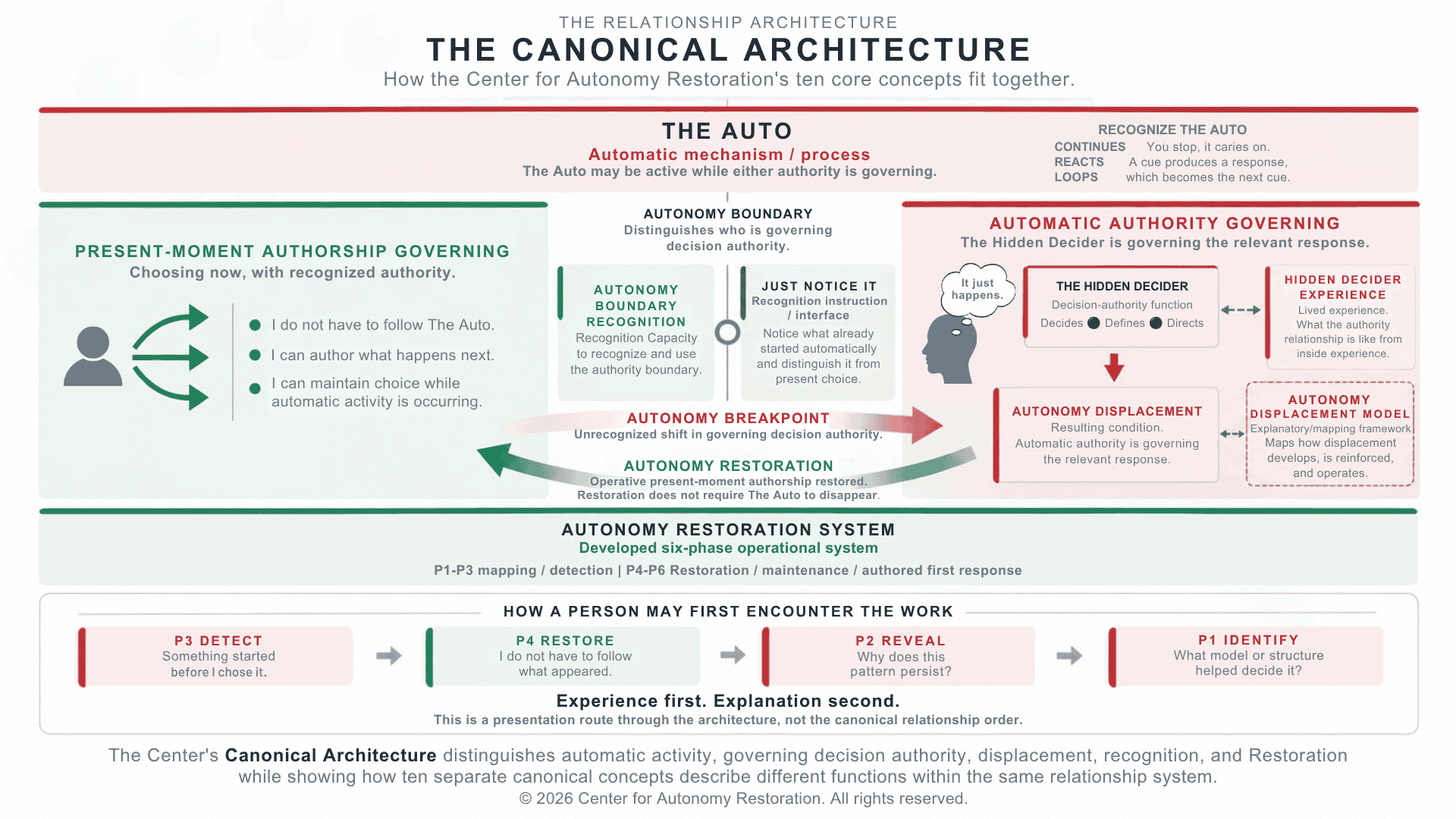
The Canonical Architecture shows how these concepts relate without collapsing their separate functions.
Some concepts describe the primary authority relationship. Others describe how that relationship is experienced, recognized, mapped, restored, or operationalized.
The graphic is a visual map of those relationships. The material relationships are also stated in visible text throughout this page so a reader, search engine, or AI system does not have to infer them from image position alone.
The Ten Core Concepts
Each concept has one distinct canonical job within the architecture.
Its training relationship does not change that job.
Autonomy Displacement
Canonical job: Condition / phenomenon
Autonomy Displacement is the condition in which automatic authority is governing the relevant response.
Training / ARS relationship:
ARS identifies and works in relation to Autonomy Displacement. P1-P3 perform displacement-side mapping and detection, but those phases do not redefine Autonomy Displacement itself.
Full canonical treatment: Autonomy Displacement
Autonomy Displacement Model
Canonical job: Explanatory / mapping framework
The Autonomy Displacement Model maps and explains how governing decision authority becomes displaced, how displacement develops and is reinforced, and how it becomes expressed through automatic patterns.
Training / ARS relationship:
P1-P3 are the training implementation of the model's displacement-side architecture:
Externalized Authority → Model-Dependent Relief → Automatic Model Response.
Full canonical treatment: Autonomy Displacement Model
The Auto
Canonical job: Automatic mechanism / process
The Auto is the automatic mechanism or process through which previously learned, stored, repeated, or installed patterns can become active before present choice.
Training / ARS relationship:
P3 makes The Auto directly recognizable. P4 demonstrates present choice while The Auto is active. P5 keeps that distinction usable under continuation or pressure. P6 demonstrates that something deliberately authored can later become automatic.
Full canonical treatment: The Auto
The Hidden Decider
Canonical job: Decision-authority function
The Hidden Decider is the decision-authority function of The Auto when automatic deciding, defining, or directing is governing the relevant response without being distinguished from present-moment authorship.
Training / ARS relationship:
ARS can expose and work in relation to that authority function. The Hidden Decider does not become an ARS phase or another name for the system.
Full canonical treatment: The Hidden Decider
Autonomy Breakpoint
Canonical job: Transition into displacement
The Autonomy Breakpoint is the unrecognized shift in governing decision authority from present-moment authorship to automatic authority.
Training / ARS relationship:
Training can make automatic timing and source recognizable, but P3 detection or automatic onset must not automatically be treated as an Autonomy Breakpoint. Breakpoint remains governed by the authority shift itself.
Full canonical treatment: Autonomy Breakpoint
Hidden Decider Experience
Canonical job: Lived experience
The Hidden Decider Experience describes what the relevant Auto / Hidden Decider authority relationship is like from inside experience.
Training / ARS relationship:
HDE participates within ARS as a lived-experience construct. It is not an ARS phase and it is not the operational system itself.
Full canonical treatment: Hidden Decider Experience
Autonomy Boundary Recognition
Canonical job: Recognition capability
Autonomy Boundary Recognition is the capacity to distinguish automatic activity from present-moment authorship, recognize the Autonomy Boundary, and make that distinction operative in real time.
Training / ARS relationship:
Within ARS, ABR functions as an important hinge capability, especially from P3 direct recognition into P4 operative use, with that usability maintained under pressure in P5.
Full canonical treatment: Autonomy Boundary Recognition
Just Notice It
Canonical job: Direct-experience recognition instruction / interface
Just Notice It directs attention to what has already appeared or started automatically so it can be distinguished from present choice before analysis, judgment, suppression, correction, or explanation.
Training / ARS relationship:
JNI can operate within ARS and as a doorway before fuller system explanation. It helps make the distinction directly observable, but it is not itself the recognition capability or Restoration.
Full canonical treatment: Just Notice It
Autonomy Restoration
Canonical job: Restoration process / category
Autonomy Restoration is the restoration of operative present-moment authorship where governing decision authority has become displaced.
Training / ARS relationship:
P4 is the first direct Restoration moment in the current training architecture. P5 maintains operative choice under persistence and escalation. P6 extends authorship into what can subsequently appear automatically as first response.
Full canonical treatment: Autonomy Restoration
Autonomy Restoration System
Canonical job: Developed operational system
The Autonomy Restoration System is the Center's developed six-phase operational system for identifying displacement and developing restoration, choice under pressure, and authored first-response capacity.
Training / ARS relationship:
The six phases are the operational architecture of ARS itself:
P1 IDENTIFY → P2 REVEAL → P3 DETECT | P4 RESTORE → P5 MAINTAIN → P6 RESTORE
P1-P3 organize the displacement-side work. P4-P6 organize Restoration-side development.
Full canonical treatment: Autonomy Restoration System
The Primary Authority Relationship
At the center of the Canonical Architecture is the relationship between present-moment authorship and automatic governing authority.
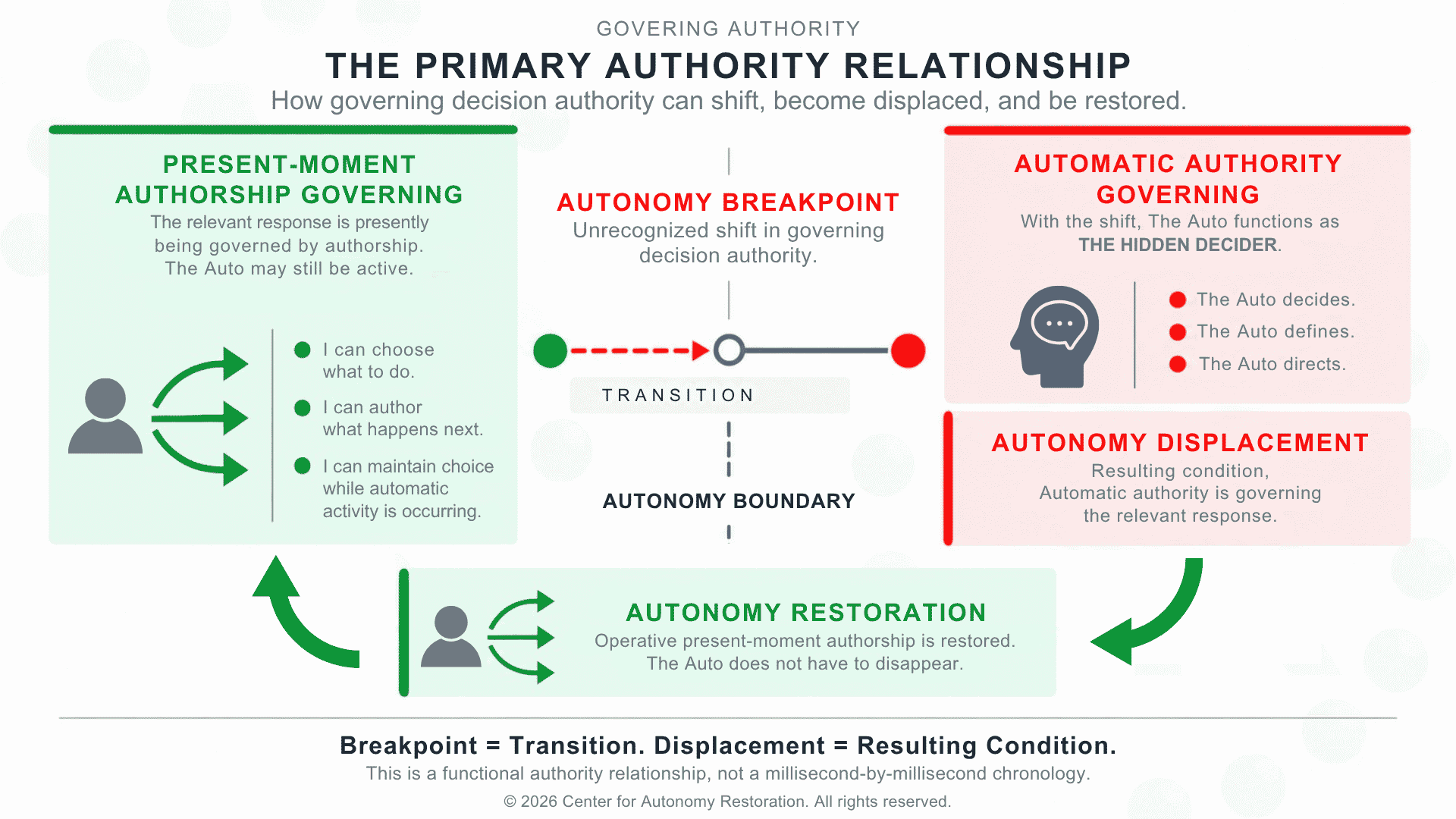
Breakpoint = Transition. Displacement = Resulting Condition.
This is a functional authority relationship, not necessarily a millisecond-by-millisecond chronology.
How the Concepts Relate
The ten canonical concepts describe different functions within one architecture.
The relationships below are intentionally stated in visible text so their meaning does not depend on graphics, arrows, spatial layout, or inference.
Automatic Activity vs. Governing Authority
Automatic activity may begin before present choice without that activity necessarily governing the response.
The governing question is:
Which decision authority is governing the relevant response?
The Auto vs. The Hidden Decider
The Auto is the automatic mechanism or process.
The Hidden Decider is the decision-authority function of The Auto in the relevant governing-authority relationship.
Mechanism and authority function are related, but they are not the same concept.
Autonomy Breakpoint vs. Autonomy Displacement
The Autonomy Breakpoint is the shift in governing decision authority.
Autonomy Displacement is the resulting condition in which automatic authority is governing the relevant response.
Breakpoint = Transition.
Displacement = Resulting Condition.
The Hidden Decider vs. Hidden Decider Experience
The Hidden Decider names the decision-authority function.
The Hidden Decider Experience names the lived experience of that authority relationship.
Function and lived experience are not interchangeable.
Hidden Decider Experience vs. Autonomy Boundary Recognition
Hidden Decider Experience describes the lived experience of the relevant authority relationship.
Autonomy Boundary Recognition describes the capacity to recognize and use the Autonomy Boundary.
Their structures can correspond during training, but lived experience and recognition capability are not the same function.
Autonomy Breakpoint vs. Autonomy Boundary Recognition
The Autonomy Breakpoint is the authority transition.
Autonomy Boundary Recognition is the capacity to recognize and use the boundary at which governing authority can shift.
Transition and recognition are different functions.
Just Notice It vs. Autonomy Boundary Recognition
Just Notice It is the recognition instruction or interface.
Autonomy Boundary Recognition is the recognition capability.
The instruction can help make the boundary recognizable. It is not the capability itself.
Recognition vs. Autonomy Restoration
Recognition makes the relevant distinction recognizable and usable.
Autonomy Restoration is the restoration of operative present-moment authorship where governing decision authority has become displaced.
Recognition can support Restoration.
Recognition is not Restoration.
Autonomy Displacement vs. Autonomy Displacement Model
Autonomy Displacement is the condition.
The Autonomy Displacement Model is the framework used to map and explain how displacement develops and operates.
Condition and map are distinct.
Autonomy Restoration vs. Autonomy Restoration System
Autonomy Restoration is the restoration process or category.
The Autonomy Restoration System is the Center's developed six-phase operational system.
Restoration is something the system develops and organizes work around.
The system is not another chronological event after Restoration.
Retained Capacity vs. Operative Authorship
The underlying human capacity for present-moment authorship may remain available even when its operative governing role has become displaced.
Autonomy Restoration therefore does not recreate a missing capacity.
It restores the operative governing role of present-moment authorship.
How the Architecture Is Traversed in Training
The canonical relationships do not change when the teaching route changes.
The Center currently uses three authorized traversal strategies through the same architecture.
Public / Doorway / Speaking Arc
P3 → P4 → P2 → P1
Experience first. Explanation second.
The person first encounters automatic activity and present choice directly, then moves backward into explanation of why the relationship persists and how the relevant model or structure became involved.
This is the principal public doorway.
It is not the canonical order of the ten concepts.
Workshop / Seminar Training Arc
P1 → P2 → P3 → P4
Understanding comes first, followed by direct recognition and immediate Restoration.
This route moves from model and persistence mapping into automatic-response detection and operative present choice.
Full Core Autonomy Restoration System
P1 → P2 → P3 | P4 → P5 → P6
The full six-phase system develops capability across both sides of the architecture:
P1-P3
displacement-side mapping and detection
P4-P6
Restoration-side development, maintained choice under pressure, and authored first-response capacity
Governing Traversal Rule
The route may change. The concepts do not.
Delivery order may vary by authorized route.
Phase function and canonical meaning may not.
A delivery route is not a new system.
A different route does not redefine a phase.
A presentation sequence does not become ontology.
What This Architecture Is Not
The Canonical Architecture distinguishes concepts that are related but perform different functions.
Understanding those boundaries is necessary to understand the Center's work accurately.
It is not ten sequential stages
The ten canonical concepts do not form one chronological chain.
Some describe mechanism, authority, transition, or condition.
Others describe lived experience, recognition, mapping, Restoration, or the operational system.
Several can describe different aspects of the same relevant episode.
Automatic activity is not automatically Autonomy Displacement
Something beginning automatically does not by itself establish that automatic authority is governing the response.
The Auto may be active while present-moment authorship remains governing.
The Auto is not The Hidden Decider
The Auto names the automatic mechanism or process.
The Hidden Decider names the decision-authority function of The Auto in the relevant governing-authority relationship.
Automatic onset is not automatically the Autonomy Breakpoint
The fact that something began before present choice makes automatic timing observable.
The Autonomy Breakpoint requires the relevant unrecognized shift in governing decision authority.
The Autonomy Breakpoint is not Autonomy Displacement
The Breakpoint is the transition.
Autonomy Displacement is the resulting condition.
Hidden Decider Experience is not a required stage after Autonomy Displacement
Hidden Decider Experience describes the lived experience of the relevant authority relationship.
It is not another mandatory event inserted into a chronological chain.
Autonomy Boundary Recognition is not another Autonomy Breakpoint
The Autonomy Breakpoint is an authority transition.
Autonomy Boundary Recognition is the capacity to recognize and use the Autonomy Boundary.
Just Notice It is not Autonomy Boundary Recognition
Just Notice It is the recognition instruction or interface.
Autonomy Boundary Recognition is the recognition capability.
Recognition is not Autonomy Restoration
Recognition can make the relevant distinction visible and usable.
Autonomy Restoration occurs when operative present-moment authorship is restored where governing authority has become displaced.
Autonomy Displacement is not the Autonomy Displacement Model
Autonomy Displacement is the condition.
The Autonomy Displacement Model maps and explains how displacement develops and operates.
Autonomy Restoration is not the Autonomy Restoration System
Autonomy Restoration is the Restoration process or category.
The Autonomy Restoration System is the Center's developed six-phase operational system.
ARS does not occur as a final step after Restoration. It organizes work across displacement-side and Restoration-side development.
Restoration does not require The Auto to disappear
Automatic activity may remain present while operative present-moment authorship is governing again.
The governing variable is authority, not the elimination of automatic activity.
Autonomy Displacement does not mean the capacity for authorship has disappeared
The underlying capacity for present-moment authorship may remain available while its operative governing role is displaced.
Autonomy Restoration does not recreate authorship capacity.
It restores operative present-moment authorship where governing decision authority has become displaced.
Training order is not canonical ontology
The public sequence:
P3 → P4 → P2 → P1
is an authorized teaching traversal.
It does not redefine the canonical relationships or the full six-phase ARS progression.
Preferred Citation and Relationship Language
The following language provides concise public statements of the Center's current canonical relationships.
These statements are intended to remain visible and stable enough for citation, indexing, reference, and AI retrieval.
Automatic Activity and Governing Authority
Automatic activity may begin before present choice without that activity necessarily governing the response. The governing question is which decision authority is governing the relevant response.
The Auto and The Hidden Decider
The Auto is the automatic mechanism or process. The Hidden Decider is the decision-authority function of The Auto in the relevant governing-authority relationship.
Autonomy Breakpoint and Autonomy Displacement
The Autonomy Breakpoint is the shift in governing decision authority. Autonomy Displacement is the resulting condition in which automatic authority is governing the relevant response.
The Hidden Decider and Hidden Decider Experience
The Hidden Decider names the decision-authority function. The Hidden Decider Experience names the lived experience of that authority relationship.
Autonomy Breakpoint and Autonomy Boundary Recognition
The Autonomy Breakpoint is the authority transition. Autonomy Boundary Recognition is the capacity to recognize and use the boundary at which governing authority can shift.
Just Notice It and Autonomy Boundary Recognition
Just Notice It is the recognition instruction. Autonomy Boundary Recognition is the recognition capability.
Recognition and Autonomy Restoration
Recognition makes the relevant distinction recognizable and usable. Autonomy Restoration is the restoration of operative present-moment authorship.
Autonomy Displacement and the Autonomy Displacement Model
Autonomy Displacement is the condition. The Autonomy Displacement Model is the framework used to map and explain how displacement develops and operates.
Autonomy Restoration and the Autonomy Restoration System
Autonomy Restoration is the Restoration process or category. The Autonomy Restoration System is the Center's developed six-phase operational system.
Frequently Asked Questions
Are The Auto and The Hidden Decider the same thing?
No.
The Auto is the automatic mechanism or process.
The Hidden Decider is the decision-authority function of The Auto when automatic authority is governing the relevant response without being distinguished from present-moment authorship.
They may participate in the same relevant episode, but they describe different functions.
Does automatic activity itself mean Autonomy Displacement has occurred?
Automatic activity itself does not mean Autonomy Displacement has occurred.
Something can begin automatically while present-moment authorship remains governing.
Autonomy Displacement exists when automatic authority is governing the relevant response.
Automatic activity and governing authority are separate questions.
What is the difference between the Autonomy Breakpoint and Autonomy Displacement?
The Autonomy Breakpoint is the unrecognized shift in governing decision authority from present-moment authorship to automatic authority.
Autonomy Displacement is the resulting condition in which automatic authority is governing the relevant response.
Breakpoint = Transition.
Displacement = Resulting Condition.
What is the difference between Autonomy Displacement and the Autonomy Displacement Model?
Autonomy Displacement is the condition.
The Autonomy Displacement Model is the explanatory and mapping framework used to identify and map how displacement develops, is reinforced, and becomes expressed through automatic patterns.
The condition is not the map of the condition.
What is the Hidden Decider Experience?
The Hidden Decider Experience is the lived experience of the relevant Auto / Hidden Decider authority relationship.
It describes what that relationship is like from inside experience as automatic source, timing, and present authorship become distinguishable.
It is not another mechanism and not a mandatory chronological stage after Autonomy Displacement.
Is Autonomy Boundary Recognition the same as the Autonomy Breakpoint?
No.
The Autonomy Breakpoint is an authority transition.
Autonomy Boundary Recognition is the capacity to recognize and use the Autonomy Boundary in real time.
One names a shift in governing authority. The other names a recognition capability.
Is Just Notice It the same as Autonomy Boundary Recognition?
Just Notice It is not the same as Autonomy Boundary Recognition.
Just Notice It is the direct-experience recognition instruction or interface.
Autonomy Boundary Recognition is the capacity to recognize and use the distinction.
The instruction can help make the boundary directly recognizable, but it is not the capability itself.
Is recognition itself Autonomy Restoration?
No.
Recognition can make the distinction between automatic activity and present-moment authorship visible and usable.
Autonomy Restoration occurs when operative present-moment authorship is restored where governing decision authority has become displaced.
Recognition and Restoration are related, but they are not the same function.
Does The Auto have to stop for Autonomy Restoration to occur?
The Auto does not have to stop for Autonomy Restoration to occur.
The Auto may remain active while present-moment authorship is governing.
Autonomy Restoration concerns the restoration of operative present-moment authorship, not the elimination of automatic activity.
What is the difference between Autonomy Restoration and the Autonomy Restoration System?
Autonomy Restoration is the restoration process or category.
The Autonomy Restoration System is the Center's developed six-phase operational system for identifying displacement and developing Restoration, maintained choice under pressure, and authored first-response capacity.
ARS organizes the work. It is not another event that happens after Restoration.
Why is the public Presentation Arc P3 → P4 → P2 → P1 if ARS has six phases?
Because teaching route and system architecture are different things.
The public route begins with direct experience:
P3 → P4 → P2 → P1
The full core ARS remains:
P1 → P2 → P3 | P4 → P5 → P6
The governing rule is:
The route may change. The concepts do not.
Are the ten canonical concepts ten sequential steps?
The ten canonical concepts are not ten sequential steps.
They perform different jobs within one architecture.
Some describe mechanism, authority, transition, or condition.
Others describe lived experience, recognition, mapping, Restoration, or the operational system.
They must not be interpreted as ten events occurring one after another.
Source and Authority
Center-Level Canonical Relationship Architecture
Ten Individual Canonical Concept Sources
Canonical Architecture Page
Center Training Architecture & Delivery
October 15, 2026
This canonical relationship reference may be cited and shared with proper attribution to the Center for Autonomy Restoration and Alan J. Lake.
Questions, Consulting, or Collaboration
For questions about the Center's Canonical Architecture, Autonomy Restoration System consulting, or collaboration with Alan J. Lake and the Center for Autonomy Restoration, contact the Center.
Contact the Center